Jungian Archetypes: What They Are and How They Return in the 22 Arcana
What Jung's archetypes are, which are the main ones, what Jung wrote about the tarot, and how you find those figures again in the Arcana of your Destiny Matrix.
November 1, 20265 minutes read
Jungian archetypes are, for Carl Gustav Jung, innate forms of the collective unconscious that you recognize in the images of myths and dreams. In the 22 Arcana of the Destiny Matrix you find some of those figures again.
Here you'll find what Jung meant by archetype, which are the main ones, the most quoted line he wrote about the tarot, and how some Jungian figures return in the arcana of your Destiny Matrix, with an example on a real date.
Free calculation
Calculate your Matrix
What archetypes are for Jung
Jung, a Swiss psychiatrist, was convinced that beneath the personal unconscious there is one common to everyone, which he called the collective unconscious. Archetypes are its forms: innate dispositions to produce certain images, found in cultures far apart from each other, in myths, in religions, in dreams. He first used the word archetype in 1919.
One point matters more than the others. For Jung the archetype itself cannot be seen. It is an empty form, like the lattice of a crystal. What you see is the archetypal image: the mother of a fairy tale, the wise old man of a film, the monster of a dream. The image changes with the culture; the form beneath stays.
The main archetypes
Jung never made a closed list. He wrote that the number of archetypes has no limit and that they blend into one another. A few, though, come back all the time in his writings.
- The Persona. The mask you show to others, the social role.
- The Shadow. The side of you that you don't recognize, the one you often see in others.
- The Anima and the Animus. The image of the feminine in a man and of the masculine in a woman.
- The Self. The totality of the person, the unity of all its parts.
- The figures. The Mother, the Father, the Child, the Wise Old Man, the Trickster.
For Jung life is a path toward the Self, which he called individuation. The first step, he wrote, is the encounter with your own Shadow.
Jung and the tarot
You often read that for Jung the 22 arcana are the archetypes. You won't find it written that way in his works. The most quoted line on the tarot is in the volume The Archetypes and the Collective Unconscious, at paragraph 81. It says that the tarot images seem to descend, distantly, from the archetypes of transformation, and that a lecture by Professor Bernoulli had confirmed this to him.
It is a cautious sentence: "seem," "distantly." Jung saw in the tarot a series of images that tells a story of change, like the figures of alchemy. Not a list of archetypes.
Archetypes and the Arcana of the Matrix
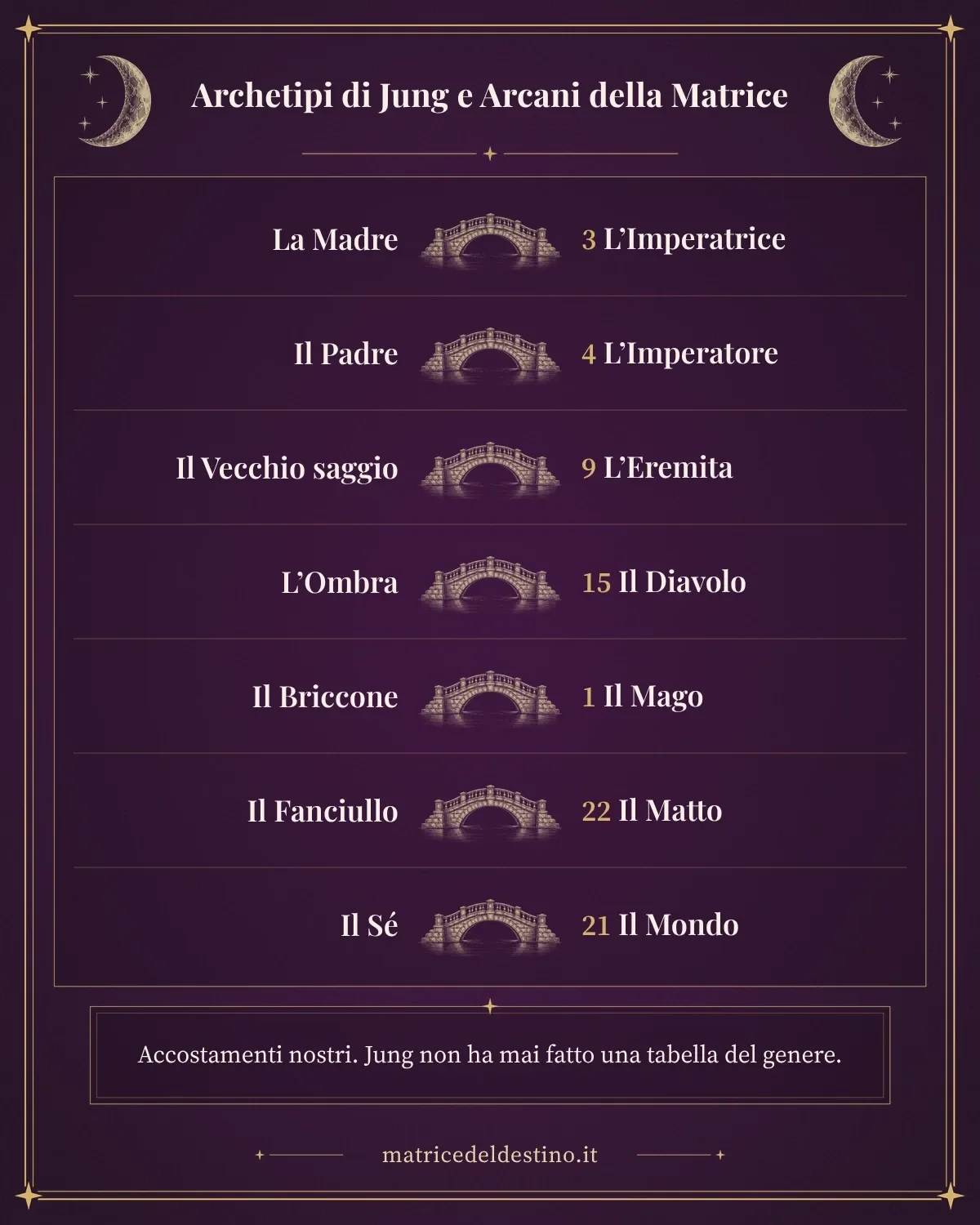
In the Destiny Matrix every number from 1 to 22 is an arcanum, and the Arcana page reminds you that each one has "its light and its shadow." Some arcana, with their alternative names, recall Jung's figures very closely.
| Jung's archetype | Arcanum of the Matrix | Why we pair them |
|---|---|---|
| The Mother | 3 The Empress | The site also calls her the Divine Mother |
| The Father | 4 The Emperor | The Ruler, Authority |
| The Wise Old Man | 9 The Hermit | The site also calls him the Sage |
| The Shadow | 15 The Devil | One of his names is exactly the Shadow |
| The Trickster | 1 The Magician | The Juggler, with a shadow of manipulation and deceit |
| The Child | 22 The Fool | Innocence and spontaneity |
| The Self | 21 The World | The Fulfillment, the Wholeness |
An example: the Shadow in the character
Let's take 06/15/1990, the site's example date. The character, point A, which the site describes as "how others see you, from 0 to 20 years," is 15, the Devil. It is the arcanum that has the Shadow among its names.
In the free result, the character 15 also has a "negative state," and the names the site uses for it are these: lack of control, self-destruction, dictator, dependent, loser. In the positive, instead: desires and passions, independence, determination. It is the same pattern as Jung's. What you don't look at governs you; what you recognize becomes strength.
The other points of the same date carry other figures. D, the point of age 60 that closes the Karmic Tail, is 4, the Emperor, the figure of the Father. The center is 8, Justice, which has no archetype next to it in the table. Not every arcanum has one, and that's fine.
The archetypes in your Matrix
To see which of these figures you carry, three steps are enough.
- Calculate your Matrix and note the character, the center and the Karmic Tail.
- Look for your numbers in the table: 1, 3, 4, 9, 15, 21 or 22.
- Read the page of those arcana and ask yourself which figure you recognize yourself in, and which one you recognize someone in your life in.
To read the points in the right order there is the article on how to read the Matrix, from the center to the Karmic Tail.
Your Matrix, read in full
If you want to know what your character, the center and the Karmic Tail say about your date, with the light and the shadow of each energy, there is the personal reading. It is a PDF written zone by zone, with concrete advice for each energy, and it reaches you by email within 48 hours.
If you prefer to start from the books, the first 120 pages of the Guide are free. We ask for your email, and by leaving it you also subscribe to the newsletter.
Questions
Frequently asked questions
What are Jungian archetypes?
For Carl Gustav Jung they are innate forms of the collective unconscious, common to all human beings. They are not seen directly: they are recognized in the images they produce, in myths, in religions and in dreams.
What are Jung's main archetypes?
Jung often names a few: the Persona, the Shadow, the Anima and Animus, the Self, and figures such as the Mother, the Child and the Wise Old Man. For him, though, the number of archetypes has no limit.
Did Jung talk about the tarot?
The most quoted line is in The Archetypes and the Collective Unconscious, at paragraph 81, where he wrote that the tarot images seem to descend, distantly, from the archetypes of transformation. He did not say that the arcana are archetypes.
Are the 22 Arcana of the Matrix archetypes?
Not in Jung's sense, for whom an archetype is an empty form and not a specific image. In the Matrix each arcanum is an energy with a light and a shadow, and some recall Jungian figures very closely, like the Hermit, whom the site also calls the Sage.
Which arcanum corresponds to the Shadow?
In the Matrix the Devil, number 15, also has the name the Shadow. But all arcana have a shadow of their own: the Arcana page reminds you of this for each of the 22.
How do I find the arcana of my Matrix?
Enter your date of birth in the free calculator. You immediately see the character, the center and the Karmic Tail, and the map with all the points.
Sources
- Wikipedia (Italian): Archetipo (psicologia)
- Wikipedia (English): Jungian archetypes
- Le Tarot cultural association: Carl Gustav Jung and the Tarot (Italian)
- Destiny Matrix: free calculator
- Personal and couple readings
- Arcanum 15, the Devil
- Arcanum 9, the Hermit
- Arcanum 3, the Empress
- Arcanum 21, the World
- Couple Matrix: calculator and reading
Read next
numerology by date of birth
Numerology by Date of Birth: Calculation and Meaning
Numerology by date of birth: which numbers come from your birth date, how to calculate them and what they mean, with a worked example and the Destiny Matrix.
November 12, 20267 minutes read
name numerology
Name Numerology: How to Calculate It and Why the Matrix Uses Only Your Date
How to calculate name numerology, what the expression number and the soul number are, and why the Destiny Matrix uses only the date of birth.
November 7, 20264 minutes read
shadow work
Shadow Work: How to Do It Starting From Your Destiny Matrix
What shadow work is, where Jung's Shadow comes from, and how to use the light and shadow of the arcana in your Destiny Matrix for guided shadow work.
November 5, 20265 minutes read